
How can I get an International Registered Report Identifier (IRRID)?
Since May 2018, authors/projects are automatically given an International Registered Report Identifier (IRRID) if they submit and publish a research protocol or proposal in the journal JMIR Research Protocols or other participating journals.
See the Glossary for important abbreviations and definitions.
Quick links for authors:
Submitting a protocol manuscript (RR1) to JMIR Research Protocols
Submitting a results manuscript (RR2) to a JMIR Publications journal
Why get an International Registered Report Identifier (IRRID)?
What is an IRRID?
An International Registered Report Identifier (IRRID) is a stable, unique identifier used to identify a protocol or proposal (RR1 papers) and link it to all subsequent results papers (RR2 papers). The IRRID is based on the DOI of the protocol paper (See What is a Registered Report? and Elements of an IRRID, below).
- IRRIDs were previously referred to as RRIDs, but to avoid confusion with the Research Resource Identifiers initiative (http://www.rrids.org), they are now referred to as IRRIDs.
- A IRRID in principle guarantees acceptance in any approved journal of the IRRID registry. All JMIR Publications journals are members of the IRRID registry.
- An RR1 IRRID — issued by JMIR Research Protocols — also signifies that the project is in principle accepted for publication in a JMIR Publications journal, after standard rigorous peer review and revisions to meet the quality of reporting standards for the journal. Also, the RR1 IRRID should be cited in the abstract of the subsequent results (RR2) paper.
Elements of an IRRID, including DOI
The IRRID consists of a prefix and a DOI, separated by a dash (-). Example: RR2-10.2196/7425.
The prefix component of the IRRID indicates the stage of the report (RR1 or RR2), as follows.
The DOI component of the IRRID is simply the DOI of the protocol or proposal (RR1) paper. The DOI consists of the following:
- A DOI prefix, indicating the publisher of the protocol/proposal (RR1) paper. Example: 10.2196 is the DOI prefix for JMIR Publications, but if the registered report is published elsewhere it would be a different number.
- A DOI suffix. At JMIR Publications, the DOI suffix is equivalent to the article ID of the final, published RR1 paper; however, not all RR1-publishers actually know the DOI before publication, in which cases the publisher may have used a manuscript tracking number or other string as the DOI suffix.
During submission
Submitting a protocol manuscript (RR1) to JMIR Research Protocols
On submission, authors should indicate the status of their protocol on the date of submission.
This will be verified by the editor or journal staff.
| Status or stage of research protocol as of the date of submission | Which prefix is appended to the RR1 IRRID? |
| Before data collection and analysis (i.e., the protocol is preregistered) | PRR1 |
| After data collection and before data analysis was fully completed. | DERR1 |
| After data collection and analysis or the timeline is undetermined | no prefix, i.e., RR1 |
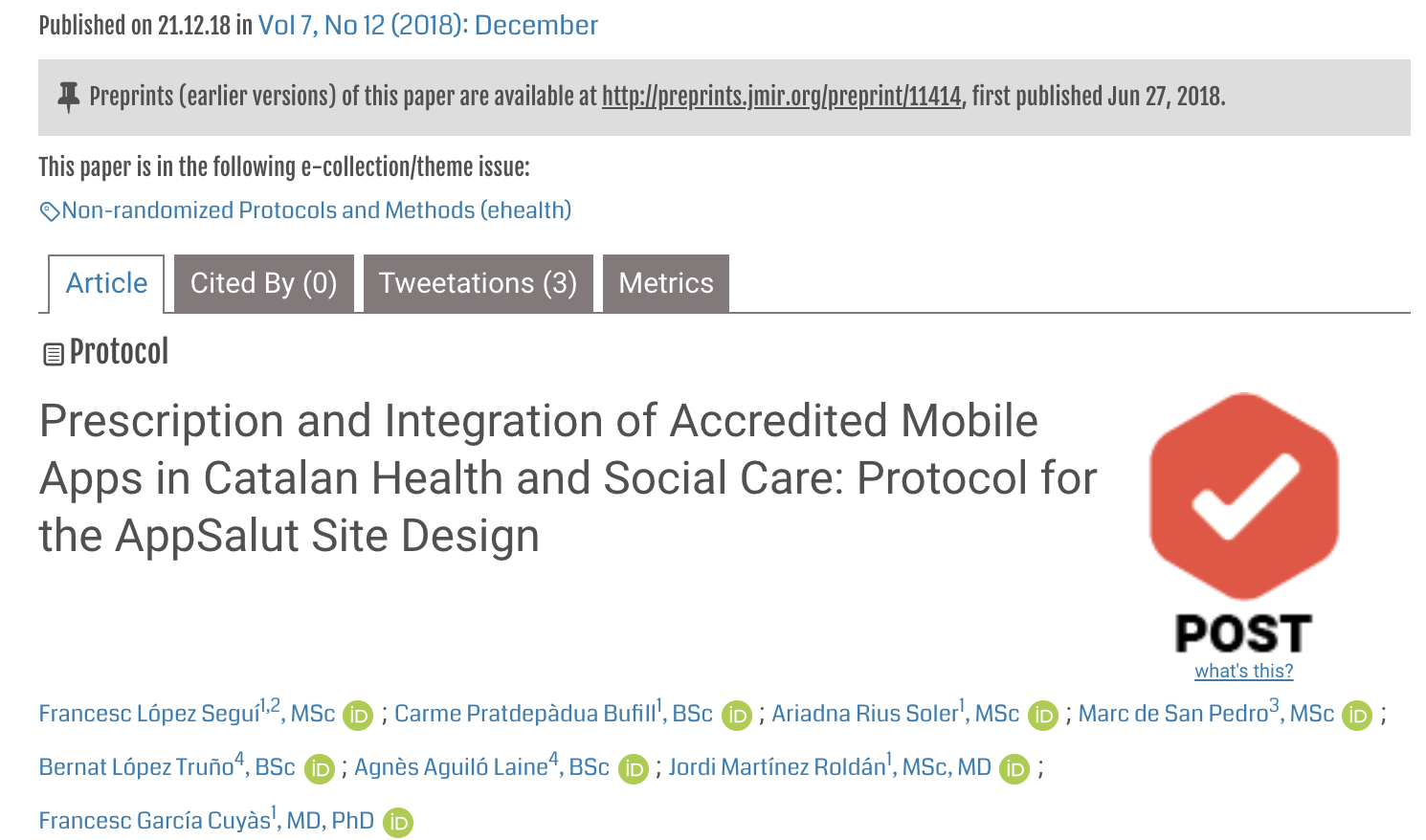
In JMIR Research Protocols, the PRE/DE/POST abbreviations are also used beneath a logo published next to the title.


Submitting a results manuscript (RR2) to a JMIR Publications journal
Authors of results papers (RR2) have the opportunity at submission to indicate which protocol (RR1) paper formed the basis of their RR2 work so that the published RR2 can link back to the relevant RR1 and vice versa.
When an author prepares their RR2, the IRRID should be used in addition to the existing clinical trials registration system (Does my trial (RCT) have to be registered?). The following screenshot shows an example of a research protocol with an assigned IRRID:
The prefix RR2 indicates a results paper, and should link back to its respective RR1.
- Note: The prefixes used on RR1 are not applied to RR2 papers.
- A prefix NP, e.g. NPRR2, indicates that the protocol was published as preprint and not peer-reviewed. This is not recommended - the IRRID registry system (https://irridregistry.org/) relies on the protocol being peer-reviewed. Publishing the protocol as preprint is encouraged, but authors should make sure that protocols are peer-reviewed by an external peer-review service. Overlay journals such as JMIRx offer peer-review services in collaboration with other partners.
General Notes on IRRID as a persistent identifier
Authors of any subsequent results paper based on a protocol (RR1) should add the IRRID to their abstract, replacing RR1 with RR2. This is in addition to citing the protocol in their reference list. The DOI portion of the IRRID remains stable.
For example, any results papers generated subsequently from a protocol with IRRID RR1-10.2196/7425 should be given the IRRID RR2-10.2196/7425. Remember that it is the DOI of the protocol that is used in all subsequent RR2s.
IRRIDs greatly facilitate the crosslinking of registered reports across journals. Please also add the Registered Report Identifier to the abstract of the results paper, even if it is not submitted to a JMIR Publications journal but to a different journal.
Use at Other Publishers
IRRIDs are a proposal - implemented at JMIR Research Protocols and all JMIR Publications journals - to link protocols to results papers and vice versa.
We hope to form an international collaboration with other publisher who adopt this format and encourage the publication of protocols / registered reports to improve accountability and quality of research.
We invite other publishers and journals to adopt the IRRID system to link back to protocols/registered reports when they publish results (RR2) papers by identifying IRRIDs in the abstract.
If you are an editor/publisher and wish to adopt this format and want to be listed as partner journal/publisher, please contact support@jmir.org.
Glossary
RR1: Registered Report, stage 1. This is a published protocol manuscript.
RR2: Registered Report, stage 2. This is a published results manuscript, which references and is based on the RR1.
IRRID: International Registered Report Identifier. This is a stable, unique identifier used to identify a protocol or proposal (RR1 papers).
See also:
- What is a Registered Report?
- Why should I publish my protocol or grant proposal?
- (for staff) Registered Report Documentation
Links: